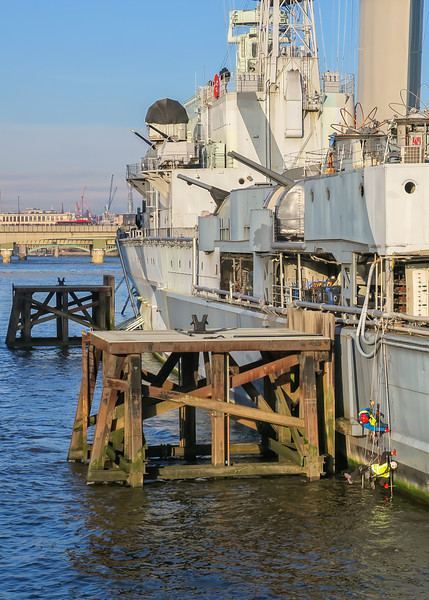
Preparing the surface to the right standard
Coating failures are almost always preparation failures. We prepare to a defined standard rather than to appearance:
- Hand and power tool cleaning to St 2 or St 3 where blasting is impractical or containment is restricted.
- Abrasive blasting to Sa 2½ where the specification calls for near-white metal.
- Wet abrasive blasting where dust control, spark risk or adjacent live equipment rule out dry blasting.
- Needle gunning and scaling on heavy scale and weld spatter.
Blast media is selected for the substrate and specification — garnet, crushed glass or ceramic beads. Containment and recovery systems keep the debris off the deck and out of the water.
Coatings applied to specification, checked as we go
We apply primer, intermediate and top coats from major manufacturers to the specified system. Our technicians record ambient temperature, relative humidity, substrate temperature and dew point before application, and check wet and dry film thickness during and after.
In the splash and tidal zones, we apply the specialist systems those areas require — high-build epoxies, petrolatum tape systems and protective wraps.
Building corrosion works into your shutdown window
Corrosion control rarely runs in isolation. It normally sits inside a wider inspection and maintenance programme on the same asset.
RAIL combines corrosion campaigns with industrial maintenance, wind turbine tower and blade work, and oil and gas shutdown scopes — one safety case, one set of certifications, one mobilisation.
Our technicians are IRATA certified, confined-space trained and supervised on site by an IRATA Level 3.
Plan your corrosion control campaign
Whether you need a single high-level repair, a full elevation recoat or a multi-week shutdown programme, contact RAIL. We will survey the asset, agree the coating system with you and deliver the works to the integrity standard your asset requires.